Jensen Huang Just Told Every CEO Their Job Has Changed
There was no suspense at GTC 2026. Before Jensen Huang even walked onstage at the SAP Center in San Jose on March 16, every attendee already knew the headline: agents.
Not chatbots. Not copilots. Autonomous AI systems that call tools, manage files, send emails, and coordinate sub-agents with minimal human oversight. Huang spent over two hours laying out how NVIDIA plans to own the entire infrastructure stack beneath this shift, from silicon to software to space-based data centers.
The pitch was blunt. Every SaaS company will become an “Agent-as-a-Service” company. Every CEO must answer one question: what is your OpenClaw strategy? And NVIDIA, conveniently, has the hardware, the frameworks, and the reference architectures to power all of it.
Vera Rubin: The Architecture Built for Agent Workloads
The centerpiece announcement is the Vera Rubin platform, a complete rack-scale AI system comprising seven chip types, five rack configurations, and what NVIDIA calls an “AI supercomputer for agents.”
This is not a single GPU upgrade. It is a vertically integrated system: the Rubin GPU, the Vera CPU, NVLink 6 switches, ConnectX-9 SuperNICs, BlueField-4 DPUs, Spectrum-6 Ethernet switches, and the newly integrated Groq 3 LPU. According to NVIDIA’s own benchmarks, the full NVL72 rack promises up to a 10x reduction in cost per token at inference compared to the Blackwell generation. That specific claim, however, comes with a critical asterisk. The 10x figure is benchmarked on the Kimi-K2-Thinking model (a Mixture of Experts architecture) at 32K input / 8K output sequence lengths. For dense model inference, Barrack AI’s March 2026 technical breakdown estimates a more realistic 2x to 3x improvement over Blackwell.
Here are the raw numbers on the Rubin GPU: 336 billion transistors, 288 GB of HBM4 memory, and 50 petaflops of FP4 inference performance per chip. Built on TSMC’s 3nm process, it represents a full node shrink from Blackwell’s 4NP node.
The Vera CPU is equally significant. Featuring 88 custom Olympus cores with what NVIDIA calls Spatial Multithreading, the chip uses LPDDR5X memory and delivers up to 1.2 TB/s of memory bandwidth. NVIDIA claims it is 50% faster and twice as energy-efficient as traditional rack-scale CPUs. Huang was direct about its commercial potential: he called it “absolutely a multi-billion dollar business,” despite the company never having planned to sell standalone CPUs.
The rack-level interconnect story is just as aggressive. NVLink 6 delivers 260 TB/s of aggregate bandwidth across a 72-GPU domain. NVIDIA also showed the Kyber rack design for the upcoming Vera Rubin Ultra, which will connect 144 GPUs in a single NVLink domain when it ships in 2027.
The Groq LPU: Disaggregated Inference Hits Production
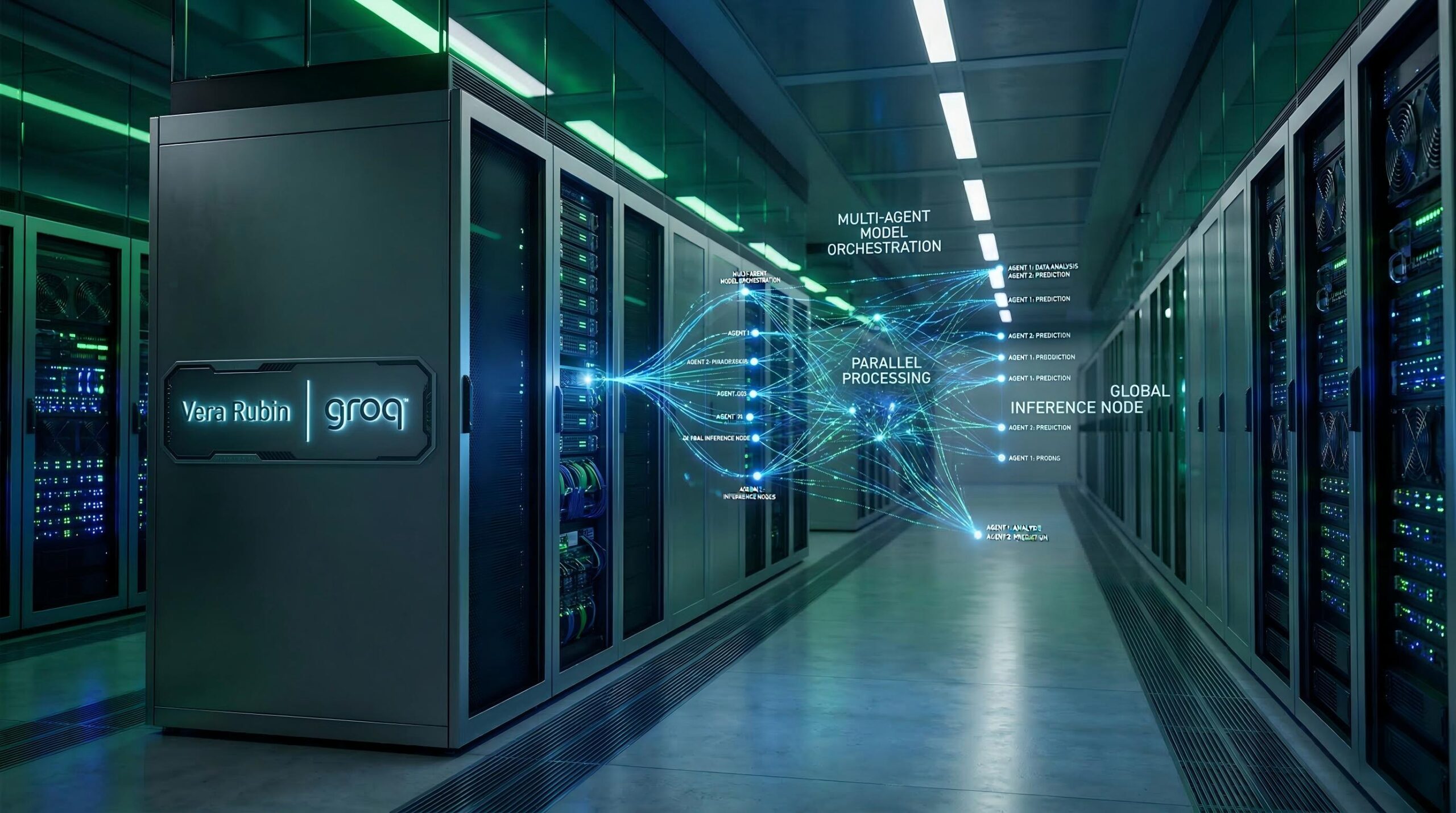
Perhaps the most architecturally interesting reveal was the formal integration of Groq’s Language Processing Unit (LPU) into NVIDIA’s stack.
NVIDIA’s $20 billion acquisition of Groq’s assets, announced on Christmas Eve 2025, was the largest deal in the company’s history. Groq was founded by creators of Google’s tensor processing unit (TPU), which competes with NVIDIA for AI workloads. The deal was structured as a non-exclusive licensing agreement to sidestep antitrust scrutiny, but around 90% of Groq employees joined NVIDIA, and shareholders received payouts based on the $20 billion valuation.
At GTC, Huang unveiled how the two architectures work together through a concept he called “disaggregated inference,” orchestrated by NVIDIA’s Dynamo software:
- The compute-heavy prefill and attention phases run on Vera Rubin GPUs, which excel at throughput.
- The latency-sensitive decode phase (token generation) offloads to Groq LPUs, purpose-built for speed.
The contrast between the two processor types is stark: a Rubin GPU provides 288 GB of HBM4 at 22 TB/s bandwidth, while the LPU trades capacity for raw bandwidth, delivering 80 TB/s from its SRAM pool per chip. A single LPX rack houses 256 Groq 3 LPUs with approximately 128 GB of aggregate on-chip SRAM and 640 TB/s of scale-up bandwidth.
NVIDIA claims this combination delivers up to 35x higher inference throughput per megawatt for trillion-parameter models. The LPX rack is expected to ship alongside Vera Rubin systems in H2 2026.
OpenClaw and NemoClaw: NVIDIA’s Agent Software Play
Hardware aside, the second half of Huang’s keynote focused on software, specifically OpenClaw, the open-source agentic AI framework created by Austrian developer Peter Steinberger.
OpenClaw achieved popularity in late January 2026 and had accumulated 247,000 GitHub stars and 47,700 forks by early March. Unlike traditional chatbots, it runs locally, maintains persistent memory, and can autonomously execute multi-step workflows across messaging apps, email, calendars, and file systems.
Huang compared OpenClaw to Linux and HTML, calling it the operating system for personal AI. NVIDIA’s response is NemoClaw, an enterprise-grade reference stack built on top of OpenClaw. The platform includes NVIDIA’s OpenShell runtime, privacy and security controls, and integration with NVIDIA’s NeMo agent software suite. It is hardware-agnostic and runs on everything from RTX PCs to DGX systems.
The security framing is deliberate. Cisco’s AI security research team tested a third-party OpenClaw skill and found it performed data exfiltration and prompt injection without user awareness. OpenClaw agents have been tricked into uploading sensitive data, including financial information and crypto wallet keys. NemoClaw is NVIDIA’s answer to this trust gap: enterprise guardrails for an inherently risky technology.
For NemoClaw, NVIDIA also assembled a coalition of partners for its Nemotron 4 model development, including Black Forest Labs, Cursor, LangChain, Mistral, Perplexity, Sarvam, and Mira Murati’s Thinking Machines.
DLSS 5: AI Eats Computer Graphics
The consumer-facing highlight was DLSS 5, which Huang described as the fusion of structured 3D rendering with generative AI.
Traditional 3D pipelines produce deterministic, controllable imagery. Generative models produce photorealistic output but with hallucination risk. DLSS 5 combines both: it uses conventional 3D data as a structural backbone, then applies generative AI to fill in detail and enhance quality. The result, according to NVIDIA, is imagery that maintains geometric accuracy while achieving near-photorealistic texture quality.
Huang also framed this as a broader industry thesis. The same logic of combining structured data with probabilistic computation will apply across industries, from medical imaging to autonomous driving perception. Whether DLSS 5 delivers on that promise in games first remains to be seen; independent benchmarks are not yet available.
The $1 Trillion Infrastructure Forecast
Huang projected that global AI infrastructure spending will reach at least $1 trillion through 2027, up from the $500 billion estimate NVIDIA gave last year. The company has been expecting growth in 2026 to exceed what was included in its earlier projection for a $500 billion revenue opportunity between Blackwell and Rubin.
This projection is underpinned by a few hard data points. NVIDIA reported record Q4 FY2026 revenue of $68.1 billion and full fiscal year 2026 revenue of $215.9 billion, with data center accounting for roughly 90% of total revenue. The inference market, according to Deloitte’s 2026 TMT Predictions, is expected to represent two-thirds of total AI compute demand by the end of 2026.
Huang also pointed to efficiency gains as the real growth driver. He cited one example where, after NVIDIA software and algorithm updates, Fireworks (an inference provider) saw its token generation speed jump from 700 tokens per second to nearly 5,000, a 7x improvement on the same hardware.
NVIDIA is now treating data centers as “token factories” where output is measured in tokens per watt, and real estate, power, and cooling set the production ceiling.
Space, Robots, and RoboTaxis: The Physical AI Push
The keynote’s final act covered physical AI across three domains:
- Autonomous driving. NVIDIA’s RoboTaxi Ready platform added four major partners: BYD, Geely, Isuzu, and Nissan, joining Mercedes, Toyota, and GM. These seven OEMs collectively produce tens of millions of vehicles annually. NVIDIA also announced a partnership with Uber to deploy RoboTaxi-ready vehicles on Uber’s ride-hailing network.
- Robotics. Partnerships with ABB, Universal Robots, KUKA, and Caterpillar will bring NVIDIA’s physical AI models into manufacturing and heavy industry. Disney’s Olaf robot, powered by a Jetson computer and trained in NVIDIA’s Omniverse simulation environment, appeared on stage as a live demo.
- Space. NVIDIA’s Thor chip has passed radiation hardening certification for orbital use. The company is developing a “Space-1 Vera Rubin” computing module for satellite-based data centers. Huang acknowledged the extreme thermal challenges (no convective cooling in space) but confirmed active engineering work.
Competitive Market Structure: How Much Room Does NVIDIA Actually Have?
NVIDIA’s GTC announcements do not exist in a vacuum. The competitive picture is shifting, even if slowly.
| Feature | NVIDIA Vera Rubin NVL72 | AMD Instinct MI450 (Projected) | Intel Gaudi 3 |
|---|---|---|---|
| Process Node | TSMC 3nm | TSMC 3nm (chiplet) | TSMC 5nm |
| GPU/Accelerator Memory | 288 GB HBM4 per GPU | 432 GB HBM4 per GPU | 128 GB HBM2e |
| FP4 Compute (per chip) | 50 PFLOPS | 40 PFLOPS | N/A |
| Memory Bandwidth (per chip) | 22 TB/s | 19.6 TB/s | ~3.7 TB/s |
| Scale-Up Bandwidth | 3.6 TB/s NVLink 6 | 3.6 TB/s (UALink) | PCIe Gen 5 |
| Software Ecosystem | CUDA (dominant) | ROCm (growing) | OneAPI (niche) |
| Cost-per-Token Claim | 10x lower vs. Blackwell (MoE) | TBD | Competitive on inference |
| Availability | H2 2026 | Q3 2026 (projected) | Available now |
| Key Advantage | Ecosystem lock-in, full-stack integration | Memory capacity, open ecosystem, TCO | Price, power efficiency vs. H100 |
Sources: NVIDIA GTC 2026 (March 2026), AMD Financial Analyst Day (November 2025, via HotHardware), TechTarget (2026), Barrack AI technical analysis (March 2026).
AMD’s market share in AI accelerators has grown to nearly 10% by early 2026, and AMD projects the MI450 will deliver 40 PFLOPS of FP4 compute with 432 GB of HBM4 per chip, significantly more memory per accelerator than Rubin. AMD’s MI400 series is positioning itself as the choice for companies seeking roughly 80% of NVIDIA’s performance at a meaningfully lower total cost of ownership.
Meanwhile, hyperscalers are investing heavily in custom silicon. AWS (Trainium), Google (TPU), and Microsoft (Maia) all reduce their dependency on NVIDIA. Broadcom has emerged as a key partner for custom silicon projects, including the rumored OpenAI inference chip.
Intel, however, is struggling. Despite progress in foundry services, Intel’s Gaudi 3 accelerators are having difficulty gaining traction in high-end training markets, leaving the company focused on edge AI and consumer PCs.
The bottom line: NVIDIA’s CUDA moat and full-stack integration remain its strongest competitive advantage. But the window for credible alternatives (especially AMD’s MI450 and hyperscaler custom chips) is widening, not shrinking.
The Real Trade-Offs Nobody Talked About
Huang’s keynote was masterfully constructed, but several important tensions went unaddressed:
- Depreciation speed. NVIDIA now ships new architectures annually. TrendForce notes that this accelerated cadence could complicate adoption for enterprise users, whose hardware may become outdated within a year. A $3.5 to $4 million NVL72 rack purchased in late 2026 could be outperformed by Rubin Ultra in 2027.
- Benchmark specificity. The headline 10x cost reduction applies to MoE models at specific sequence lengths. For dense models (still widely used in production), the improvement is closer to 2 to 3x. NVIDIA did not prominently disclose this distinction during the keynote.
- OpenClaw security risk. NVIDIA’s embrace of OpenClaw is a calculated bet. The platform remains an alpha-stage project with known RCE vulnerabilities and active prompt injection attacks in the wild. In March 2026, Chinese authorities restricted state agencies from running OpenClaw on office systems due to security concerns. NemoClaw may mitigate some risks, but NVIDIA is tying its enterprise agent story to a framework that even its own maintainers have cautioned is dangerous for non-technical users.
- Concentration risk for customers. NVIDIA’s vertical integration is a double-edged sword. It delivers performance that no competitor can match today. But the deeper an enterprise builds into the CUDA/NVLink/NeMo stack, the higher the switching cost. Huang himself described NVIDIA as “vertically integrated yet horizontally open,” but the hardware lock-in at the rack level is real.
Verdict: NVIDIA Is Building the Tollbooth for the Agent Economy
GTC 2026 was not really a product launch event. It was a strategic declaration. NVIDIA is positioning itself as the indispensable infrastructure layer for an economy where AI agents, not humans, are the primary consumers of compute.
The technical execution is impressive. Vera Rubin’s rack-scale co-design, the Groq LPU integration for disaggregated inference, and the NemoClaw enterprise stack form a coherent, full-stack offering that no competitor can replicate today. The 10x cost-per-token claim (even with its MoE-specific caveats) represents a real generational leap in inference economics.
But NVIDIA’s ambition also creates fragility. Annual architecture refreshes risk alienating enterprise customers with short hardware lifecycles. The OpenClaw bet introduces security liabilities that could damage enterprise trust. And the growing capabilities of AMD’s MI450, hyperscaler custom silicon, and even Groq-style ASIC challengers mean the competitive moat, while still deep, is not bottomless.
For infrastructure buyers, the practical takeaway is straightforward: if you are committed to the CUDA ecosystem, Vera Rubin is the upgrade path, and cloud availability from AWS, Azure, Google Cloud, and CoreWeave is expected in late 2026. If you are evaluating alternatives, AMD’s Helios platform and hyperscaler-native chips deserve serious proof-of-concept testing, particularly for memory-heavy workloads.
For everyone else, the message from San Jose is harder to ignore: the agentic AI era has arrived, and NVIDIA already owns the tollbooth.